Building a Mobile App for Your Business: What to Know Before You Start
Thinking about launching a mobile app? Before you write a single line of code, learn the critical strategic, financial, and technical decisions that separate apps that drive growth from those that collect dust in the App Store.

For any ambitious founder, the idea of launching a dedicated mobile app for their business is incredibly exciting. It represents a major milestone—a tangible expansion of your brand right onto the screens of your customers' most personal devices.
Whether you want to build a mobile companion for your B2B platform, launch a direct-to-consumer e-commerce app, or build a brand-new mobile-first product from scratch, the business case sounds fantastic: higher user retention, direct access via push notifications, and a completely controlled user experience.
However, the landscape of mobile app development is littered with expensive, abandoned software. Many businesses spend tens of thousands of dollars building an app, only to watch it sit in the App Store with double-digit downloads and zero active usage.
Why does this happen? Because moving from a standard web platform to a mobile application requires an entirely different strategic, financial, and technical approach.
Before you write a single line of code or hire a development team, here is exactly what you need to know to ensure your mobile application drives measurable business growth rather than burning your operational capital.
1. The Core Question: Do You Need an App or a Responsive Website?
The single biggest mistake founders make is building a mobile app that does the exact same thing as their existing website.
If a customer can access your platform via a mobile web browser and complete their tasks perfectly without friction, forcing them to download an app from the App Store is a massive barrier to entry. Every step required to use an app—finding it, clicking download, waiting for it to install, entering credentials—is a point where a user will drop off.
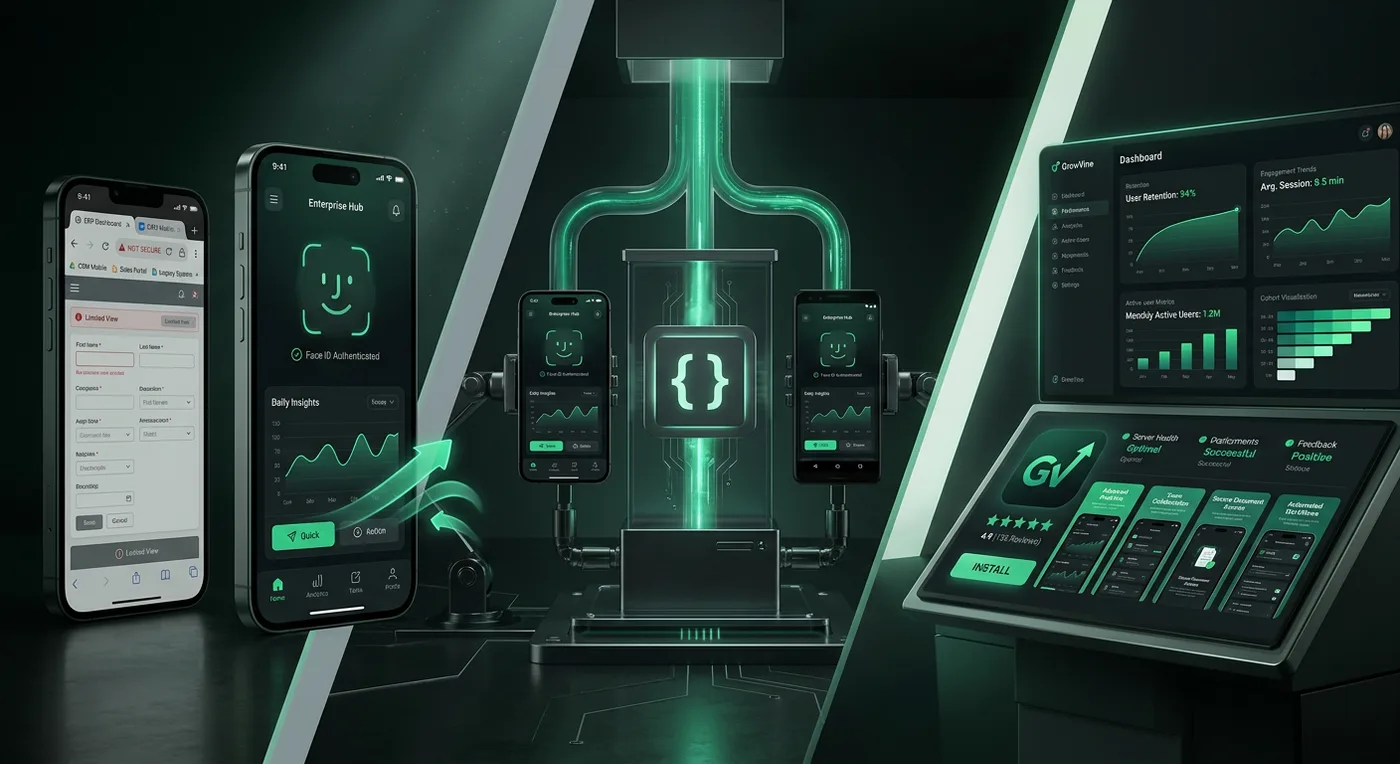
A mobile app makes strategic sense only when it leverages the unique, native capabilities of a smartphone to provide value that a web browser simply cannot replicate. This includes:
- Real-time, context-aware push notifications.
- Hardware integrations like the camera, biometrics (FaceID/TouchID), GPS location tracking, or Bluetooth.
- Offline functionality, allowing users to complete vital workflows without an active internet connection.
- High-performance interactivity or complex, smooth gesture-based user interfaces.
If your app doesn't offer a fundamentally better, more integrated experience than a standard browser window, your users will simply delete it to save space.
2. Navigating the Architecture Tradeoff: Native vs. Cross-Platform
When you decide to build, you will face a critical technical choice: Do you build native apps or a cross-platform app?
Native Development: This means building two completely separate applications—one in Swift for Apple iOS, and one in Kotlin for Google Android. This delivers the absolute highest performance, fastest load times, and deepest access to phone hardware, but it effectively doubles your development and long-term maintenance costs.
Cross-Platform Development: Using modern frameworks like Flutter or React Native allows developers to write a single codebase that deploys seamlessly to both iOS and Android stores simultaneously. For 90% of business applications, cross-platform development is the smartest choice. It slashes your time-to-market, drastically lowers upfront capital requirements, and streamlines your future updates into a single pipeline.
3. Account for the Invisible Costs of App Ownership
The budget for a mobile application doesn't stop the moment your app goes live on the store. Unlike standard web pages, mobile apps require active, ongoing lifecycle management.
Store Maintenance & Compliance: Apple and Android continuously update their operating systems (OS) every year. When a new version of iOS drops, it frequently introduces security policy adjustments or changes that can break legacy app features. You must allocate resources for regular updates to avoid performance crashes.
App Store Optimization (ASO): Just like traditional SEO, getting discovered in the App Store requires a deliberate keyword, imagery, and review strategy. If you don't optimize your store listing, your app will remain completely invisible to organic searchers.
Aligning Product Design With Business Velocity
At GrowVine, our core engineering framework is explicitly designed to guide ambitious companies From Vision to Growth. We don't believe in building complex technology just for the sake of it—every product we ship must act as an engine for revenue and operational leverage.
We bring this exact mindset of ruthless technical optimization to every project we touch. For instance, when engineering public-facing digital ecosystems and high-performance e-commerce engines, we focus intensely on core speed, clean layout flows, and technical SEO structure. By eliminating underlying software bloat and aligning user interfaces with human behavior, we have successfully driven major client transformations, including a 40% increase in online sales alongside pristine, top-tier technical performance scores.
Whether you are launching a public-facing storefront or engineering a premium mobile experience from the ground up, your software must be fast, intuitive, and explicitly engineered to convert attention into business value.
From Concept to App Store: The Smart Path Forward
If you want to build a mobile app that succeeds, do not start with a massive, multi-month development contract covering 50 different complex features.
Start with a lean, hyper-focused Minimum Viable Product (MVP). Map out the absolute single most important action your user needs to take, design a flawless user interface around that action, and get it into the hands of real users in weeks rather than quarters. Validate the user data first, then iterate and scale your features based on real market demand.
Ready to build a mobile asset that moves your actual business metrics? Book a 30-minute system consultation with GrowVine today. We will audit your product idea, break down the native vs. cross-platform economics for your specific audience, and map out an explicit blueprint to take your vision from a concept sketch straight to a high-performing app store listing.
About the Author
Popular Posts

B2B Automation in 2026: How Smart Companies Are Replacing Manual Outreach (and SaaS Bills)
Jul 14, 2026
From Spreadsheets to Systems: When Your Business Has Outgrown Manual Workflows
Jul 13, 2026
Building a Mobile App for Your Business: What to Know Before You Start
Jul 13, 2026
The Real Cost of Disconnected Tools: How Multiple Vendors Quietly Kill Your Growth
Jul 13, 2026Stay Updated
Subscribe to our newsletter and get the latest insights straight to your inbox.